
In this article
Author: Dr Károly Krkos, laboratory medicine specialist
In his professional work, laboratory medicine specialist Dr Károly Krkos focuses in particular on the practical interpretation of food intolerance tests, IgG-based laboratory results and elimination diets.
Migraine is an episodic disorder centred on a severe headache that is often accompanied by nausea and avoidance of light and sound1.
In the United States, 18% of women and 6% of men are affected5. According to the diagnostic criteria of the International Headache Society (IHS)2, migraine can be diagnosed if the patient has had at least 5 attacks of intractable headache lasting 4–72 hours and at least two of the following features are observed:
You can read more about the possible causes of headache and migraine, and when to ask for a medical check-up, on our headache page.
• one-sided location
• pulsating quality
• moderate or severe pain intensity
• symptoms that worsen with routine physical activity (e.g. walking, climbing stairs) or cause it to be avoided altogether
• in addition to the headache, at least one of the following symptoms occurs:
- nausea and/or vomiting
- avoidance of light and sound
Migraine is often accompanied by aura3,
• which may precede or follow the migraine attack, but may also occur on its own,
• develops over 5–20 minutes and lasts less than 60 minutes
• most often involves visual symptoms, but other sensory and motor symptoms or combinations of these may also occur
• the visual symptoms may be positive or negative
• the most characteristic is a flickering, circumscribed visual field defect (scotoma), arc- or band-shaped, with a flickering or shimmering zigzag border.

Its exact cause has not yet been clarified. In the forms with aura, CSD (cortical spreading depression) may explain how the phenomenon arises (CSD: a wave of excitation in the cortical grey matter that spreads at 2–6 mm/minute, triggered by the release of potassium or glutamic acid, which in turn causes several neurotransmitters to be released). CSD activates the trigeminovascular system, which stimulates the nociceptive neurons of the blood vessels of the dura mater, and pain-inducing substances are released: calcitonin gene-related peptide (CGRP), substance P, neurokinin A1,3. The result is sterile inflammation. In addition, CSD also activates the genes encoding the following molecules: COX2 (cyclo-oxygenase-2), TNF-alpha, IL-1-beta, galanin, metalloproteinases)3.
The inheritance of a predisposition to the disease is shown by the fact that in 70% of migraine patients a direct (lineal) relative is also affected. A clear (usually autosomal dominant) pattern of inheritance can be shown in a few rare disorders associated with migraine.
Factors that trigger migraine attacks4:
• hormonal changes (menstruation, ovulation, pregnancy)
• stress
• sleep disturbances (too much or too little sleep)
• medicines (e.g. vasodilators, contraceptives)
• smoking
• bright light
• strong smells
• head injury
• changes in the weather
• fasting
• foods/drinks and food ingredients that have been linked to triggering attacks:
o caffeine,
o sweeteners (e.g. aspartame, saccharin
o glutamate
o citrus fruits
o tyramine-containing foods (e.g. mature cheeses)
o meats containing nitrite
Numerous studies have reported that consuming products involved in triggering headache is associated with raised levels of immunoglobulins, complement products and circulating immune complexes, and with local mast cell degranulation6. When IgG and IgE levels against food components were measured, IgG levels were raised in the samples of all patients examined, IgE levels less so. Patients who had not improved with conventional treatment (n=65) were started on an elimination diet based on an IgG test. Complete remission was found in 43 patients (out of the 65). Among the people studied, 6 had both migraine and colitis. Both conditions improved significantly as a result of the diet.
The intervention is effective if the dietary change is strictly followed. If the diet is broken, symptoms return within a few days6.
According to a literature review analysing the links between diet and migraine7, of the possibilities raised so far, the role of food-specific IgE and the presumed reduced activity of amine-oxidising enzymes (MAO A and MAO B) and the enzymes that sulphate them (phenol sulfotransferase M and P) has not been clearly confirmed; however, more and more data are emerging on the beneficial effect of an elimination diet based on food IgG testing.
A double-blind, randomised, cross-over study8 examined 30 patients with migraine without aura. For 6 weeks, the IgG-positive components were removed from the diet of half of the patients, while the other group continued to eat these foods. After a subsequent 2-week diet-free period, a further 6-week elimination followed in the group that had not previously been on the diet, while those who had dieted in the first phase received IgG-positive foods. There was a significant difference between the dieting and non-dieting groups (in both the first and the second phase) in the number of headache days and the number of migraine attacks, so the beneficial effect of leaving out IgG-positive foods was demonstrated.
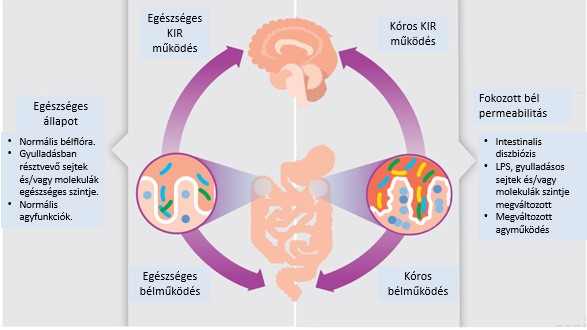
Migraine is more common among patients with irritable bowel syndrome (IBS), inflammatory bowel disease (IBD) and coeliac disease. Mothers with migraine experience colic attacks in their babies more often, and children with migraine more often struggled with colic in infancy. Numerous studies have demonstrated a link between IBS, IBD, coeliac disease and migraine. The link between these conditions is a change in intestinal permeability and the development of inflammation9. In addition, the composition and balance of gut microbes also plays an important role in the proper functioning of the microbiota–gut–brain axis.
Figure: the microbiota–gut–brain axis9
Patients diagnosed with irritable bowel syndrome who suffered from migraine attacks were divided into 3 groups: the first group received an elimination diet based on an IgG test, the second group received probiotics, and the 3rd group received both an elimination diet and probiotics for two weeks10. Migraine symptoms, bowel function (gut function score) and serum serotonin levels were assessed on days 0, 7 and 14.
Bowel complaints improved and migraine symptoms eased during the study. The improvement in the measured parameters was significant in those who received the elimination diet and in those who received the combined treatment (diet and probiotic).
The effect of an elimination diet based on an IgG test was also examined in a double-blind, randomised, controlled cross-over study11. The number of migraine attacks, their maximum and average duration, the frequency and severity of abdominal pain due to bloating, and quality of life improved significantly during the dietary change, while the provocation diet had the opposite effect.
References:
| 1 |
F M Cutrer: Pathophysiology, clinical manifestations, and diagnosis of migraine in adults, UpToDate 2020 Oct. (Last updated: 5 November 2020), |
||||||||||||||
https://www.uptodate.com/contents/pathophysiology-clinical-manifestations-and-diagnosis-of-migraine-in-adults?search=migraine&source=search_result&selectedTitle=2~150&usage_type=default&display_rank=2 |
|||||||||||||||
2 |
Headache Classification Committee of the International Headache Society. Headache Classification Committee of the International Headache Society (IHS) |
||||||||||||||
The International Classification of Headache Disorders, 3rd edition. Cephalalgia, 2018 Jan. 38 (1):1-211 |
|||||||||||||||
https://doi.org/10.1177/0333102417738202 |
|||||||||||||||
3 |
J Chavla: Migraine Headache, January 2020, Medscape, |
||||||||||||||
https://emedicine.medscape.com/article/1142556-overview |
|||||||||||||||
4 |
Wöber C, Brannath W, Schmidt K, Kapitan M, Rudel E, Wessely P, et al. Prospective analysis of factors related to migraine attacks: the PAMINA study. |
||||||||||||||
Cephalalgia. 2007 Apr. 27(4):304-14. https://doi.org/10.1111/j.1468-2982.2007.01279.x |
|||||||||||||||
5 |
Lipton RB, Scher AI, Kolodner K, Liberman J, Steiner TJ, Stewart WF. Migraine in the United States: epidemiology and patterns of health care use. |
||||||||||||||
Neurology. 2002 Mar 26. 58(6):885-94. |
https://doi.org/10.1212/WNL.58.6.885 |
||||||||||||||
6 |
C. M. A Hernández, M. E. Pinto, H. E. H Montiel: Food allergy mediated by IgG antibodies with migraine in adults, Revista Alergia Mexico 2007, 54(5): 162-168 |
||||||||||||||
http://citeseerx.ist.psu.edu/viewdoc/download?doi=10.1.1.473.5067&rep=rep1&type=pdf |
|||||||||||||||
7 |
J Pascuat and A. Oterino: IgG-mediated allergy: A new mechanism for migrane attacks?, Cephalalgia 2010, 30(7): 777-779 |
||||||||||||||
https://doi.org/10.1177/0333102410364856 |
|||||||||||||||
8 |
K Alpay, M Ertas, E K Orhan et al.: Diet restriction in migraine, based on IgG against foods: a clinical double-blind, randomised, cross-over trial, |
||||||||||||||
Cephalalgia 2010, 30(7):829-837, https://doi.org/10.1177/0333102410361404 |
|||||||||||||||
9 |
S van Hemert, A C Breedveld et al.: Migraine associated with gastrointestinal disorders: review of the literature and clinical implications, |
||||||||||||||
Frontiers in Neurology 2014, https://doi.org/10.3389/fneur.2014.00241 |
|||||||||||||||
10 |
Y Xie, G Zhou, Y Xu et al.: Effects of Diet Based on IgG Elimination Combined with Probiotics on Migraine Plus Irritable Bowel Syndrome, |
||||||||||||||
Pain Research and Management 2019, Article ID 7890461 https://doi.org/10.1155/2019/7890461 |
|||||||||||||||
11 |
E I Aydinlar, P Y Dikmen, A Tiftikci et al.: IgG-Based Elimination Diet in Migraine Plus Irritable Bowel Syndrome, Headache 2013, 53:514-525 |
||||||||||||||
https://doi.org/10.1111/j.1526-4610.2012.02296.x |
|||||||||||||||

Don't just get the school bag ready
Starting school is not only about new exercise books and a changed daily routine but also about reorganising family meals. The FOODTEST Children's pac...

IBS and food intolerance: can diet help?
Several factors may lie behind irritable bowel syndrome, and the role of diet may also come up. The article explains in plain terms how certain foods...

Do you have to give up tasty food with a food intolerance?
Free-from or diet cooking does not mean going without: with the right ingredients and tricks, you can make tasty, varied dishes at home too.