In this article
Author: Dr Károly Krkos
IgG produced against food components is used when the aim is not to demonstrate an immediate reaction triggered by foods (IgE-mediated, type I hypersensitivity) but to identify the factors behind later, non-allergic complaints (type III hypersensitivity). The basis of the latter is that when intestinal permeability increases for various reasons, the humoral antibody response may be activated: food antigens form immune complexes with the IgG antibodies produced against them, and these complexes are deposited in the tissues, where they trigger complement activation and inflammatory processes that may contribute to a wide range of complaints (bloating, abdominal cramps, migraine, eczema, anxiety, depression)14,15.
Of the antibodies measurable in serum, the IgG fraction has the highest concentration (about 73% of the total antibody concentration1). The IgG isotype has four subclasses: IgG1, IgG2, IgG3 and IgG4. Their main characteristics are summarised in the table below (based on reference 2):
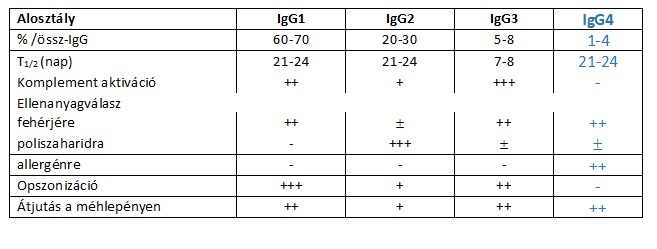
As can be seen, the subclasses have different properties. The order in which they are formed and their role in the immune response are summarised in the figure below4:
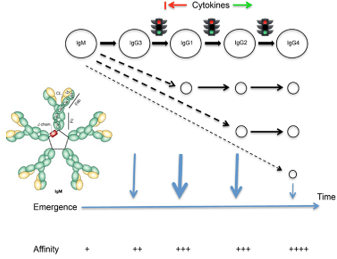
Against an antigen not yet known to the body, the immune system first starts producing low-affinity antibodies of the IgM isotype. As the immune response matures, class switching to IgG3 takes place. This immunoglobulin binds the antigen with greater affinity, activates the complement system and markedly enhances the activity of phagocytic cells (opsonisation). At the next switch, IgG1 of even higher affinity is produced, with excellent opsonising capacity and strong complement activation. In a large proportion of cases, the body succeeds in completely neutralising the antigen at this stage. If this does not happen, IgG2 is produced, with similarly high affinity but weaker opsonising and complement-activating capacity (so the inflammatory symptoms subside). With even longer-lasting antigen stimulation, IgG4 is produced, which can neither activate complement nor opsonise, and binds the antigen more strongly than all its predecessors. The formation of IgG4 therefore cannot trigger an inflammatory reaction; in fact it leads to tolerance, so it is not suitable for identifying the foods that cause complaints – in other words, an elimination diet cannot be set up on the basis of an IgG4 test14,18,19.
IgG4 also differs from the other IgG subclasses in a number of other properties:
- It blocks the allergic reaction because it binds the allergen with greater affinity than IgE, thereby preventing the allergen from cross-linking the IgE molecules bound to the Fcε receptor on the cell surface and preventing cell degranulation. In the same way, it inhibits allergen presentation to Th cells6,7,8,12,19.
- The IgG4 molecule can split in half and then recombine with half of another IgG4 molecule of different antigen specificity (Fab-arm exchange), producing a bispecific antibody2,11,17
- It binds strongly to the inhibitory FcγRIIb receptor – further inhibiting effector cell activity and inflammatory processes5,6,11,12
- Through Fc–Fc interaction, it can remove other IgG types involved in immune complex formation and opsonisation (e.g. IgG1)17
What is food-specific IgG4 used for?
One effective tool in treating allergy is to administer the allergen to the patient (allergen immunotherapy, AIT) – thereby inducing the formation of allergen-specific IgG4 and the development of tolerance. The effectiveness of the treatment is confirmed by a marked rise in allergen-specific IgG4 concentration (and a marked fall in the IgE/IgG4 ratio)5,6,8,9,10.
In patients with eosinophilic oesophagitis, IgG4 levels against cow's milk (and possibly against wheat proteins) are high. In this group of conditions, neither IgE nor IgG4 measurement guides dietary change; the patients' condition can be improved by setting up the so-called six- (or seven-) food elimination diet, while in the group that responds well to the diet, food-specific IgG4 concentration rises markedly22.
In which diseases does (total) IgG4 rise?
In recent decades, attention has turned to a group of steroid-responsive diseases involving tissue infiltration by IgG4-positive plasma cells and fibro-inflammation, the so-called IgG4-related diseases (IgG4-RD). These conditions are characterised by elevated serum IgG4 concentration3,20,21,24,25. The conditions in this group include:
- autoimmune pancreatitis (AIP)
- IgG4-related sclerosing cholangitis
- Mikulicz syndrome (sclerosing sialadenitis, a disease of the lacrimal gland and the parotid gland)
- Küttner tumour (a disease of the submandibular gland)
- IgG4-related orbital disease
- retroperitoneal fibrosis with chronic periaortitis (hydronephrosis often develops too)
- Riedel thyroiditis
- IgG4-related interstitial pneumonitis and inflammatory pseudotumour of the lung
- IgG4-RD tubulointerstitial nephritis (TIN) and membranous glomerulonephritis secondary to IgG4-RD
- IgG4-RD hypophysitis
- IgG4-RD pachymeningitis
- IgG4-RD midline destructive disease
However, a rise in IgG4 is not specific to this group of diseases; elevated serum IgG4 can be observed in many other conditions too:
- Churg–Strauss syndrome,
- multicentric Castleman disease,
- sarcoidosis,
- pemphigus,
- allergic conditions,
- chronic hepatitis,
- cirrhosis of the liver,
- systemic autoimmune diseases (rheumatoid arthritis, Sjögren's syndrome, systemic sclerosis)
- certain parasitic infections (schistosomiasis, filariasis, helminthiasis)
IgG4 is also called a "Janus-faced" antibody because, in cancers (melanoma, extrahepatic cholangiocarcinoma, pancreatic cancer, colorectal cancer, gastric cancer, glioblastoma), a rise in IgG4 levels is a poor prognostic sign, since in such cases the induction of tolerance means that tumour cells "escape" the immune system17,23.
Significantly higher total IgG4 levels have also been found in people with autism spectrum disorder compared with the neurotypical group, and IgG4 levels correlated with the degree of autism-specific impairment of social interaction16.
References
- R A Schwartz: Immunglobulin G Deficiency 2021, Medscape; https://emedicine.medscape.com/article/136897-print
- A P Knutsen, R Marsh: IgG subclasses: Physical properties, genetics, and biologic functions2022, UpToDate, https://www.uptodate.com/contents/igg-subclasses-physical-properties-genetics-and-biologic-functions/print?search=IgG%20subclasses:%20Physical%20properties,%20genetics,%20and%20biologic%20functions&source=search_result&selectedTitle=1~150&usage_type=default&display_rank=1
- H M Moutsopoulos, G E Fragoulis, J H Stone: Pathogenesis and clinical manifestation of IgG4-related diseases 2020, UpToDate; https://www.uptodate.com/contents/pathogenesis-and-clinical-manifestations-of-igg4-related-disease/print?search=IgG%20subclasses:%20Physical%20properties,%20genetics,%20and%20biologic%20functions&topicRef=3964&source=see_link
- A M Collins, K J L Jackson: A temporal model of human IgE and IgG antibody function 2013, Frontiers in Immunology; https://doi.org/10.3389/fimmu.2013.00235
- R T Strait, S C Morris, F D Finkelman: IgG-blocking antibodies inhibit IgE-mediated anaphylaxis in vivo through both antigen interception and FcgIIB cross-linking 2006, J Clin Invest, 116(3):833-841; doi: 1172/JCI25575
- A comparison between IgE and IgG4 … (G L Piacentini, S Gueressi et al., International Journal of Immunpathology and Pharmacology 2011, 24(4):1049-1056
- S Aschermann, A lux et al.: The other side of Immunglobulin G: suppressor of inflammation 2009, Clin Exp Immunol, 160:161-167; doi:10.1111/j.1365-2249.2009.04081.x
- S Piconi, D Trabattoni et al.: Effects of sublingual immunotherapy 2010, Journal of Immunology, 185:7723-7730; doi: 10.4049/jimmunol.1002465
- T A E Platts-Mills, B Keshavarz et al.: An overview of relevance of IgG4 antibodies in allergic disease with a focus of food allergens 2021, Children, 8:418, doi: 3390/children8050418
- O Smoldovskaya, G Feyzkhanova et al.: Allergen-specific IgE and IgG4 patterns among patients with different allergic diseases 2018, World Allergy Organization Journal, https://doi.org/10.1186/s40413-018-0220-5
- W van de Veen, M Akdis: Role of IgG4 in IgE-mediated response 2016, American Academy of Allergy, Asthma and Immunology; http://www.elsevier.com/open-access/userlicense/1.0/
- L K James, S J Till: Potential Mechanisms for IgG4 Inhibition of Immediate Hypersensitivity reactons 2016, Curr Allergy Asthma Rep, 16:23; DOI 10.1007/s11882-016-0600-2
- G Noh, H-S Ahn et al.: The clinical significance of food-specific IgE/IgG4 in food-specific atopic dermatitis 2007, Pediatric Allergy and Immunology, 18:63-70; DOI: 10.1111/j.1399-3038.2006.00478.x
- C Meletis: The Clinical Utility of IgG4 testing 2019, US BioTek Laboratories 2019, https://www.usbiotek.com/blog/clinical-utility-igg4-testing
- F Torrente, P Ashwood et al: Small intestinal enteropahty with epithelial IgG and complement deposition in children with regressive autism 2002, Molecular Psychiatry, 7:375-382; doi:10.1038/sj.mp.4001077
- A Enstrom, P Krakowiak et al: Increased IgG4 level in children with autism disorder 2009, Brain Behav Immun, 23(3):389-395; doi:10.1016/j.bbi.2008.12.005.
- R Bianchini, S N Karagiannis et al.: The Role of IgG4 in the Fine Tuning of Tolerance in IgE-mediated Allergy and Cancer 2020, International Journal of Molecular Science, 21:5017; doi:10.3390/ijms21145017
- S O Stapel, R Asero et al: Testing for IgG4 against food is not recommended as a diagnostic tool: EAACI task force report 2008, European Journal of Allergy and Clinical Immunology, https://doi.org/10.1111/j.1398-9995.2008.01705.x
- E Lavine: Blood testing for sensitivity, allergy or intolerance to food 2012, CMAJ; DOI: 10.1503/cmaj.110026
- K-H Yu, T-M Chan et al.: Diagnostic Performance of Serum IgG4 levels in Patients with IgG4-related disorders 2015, Medicine, 94(41); DOI: 10.1097/MD.0000000000001707
- E L Culver, R Sadler et al: Elevated Serum IgG4 levels in Diagnosis, Treatment Response, Organ Involvement, and Relapse in a Prospective IgG4-Realted Disease UK Cohort 2016, The American Journal of Gastroenterology; doi: 10.1038/ajg.2016.40
- E C McGowan, T A E Platts-Mills, J M Wilson: Food Allergy, Eosinophylic Esophagitis and the Enigma of IgG4 2020, Ann Allergy, Asthma Immunol, 122(6):563-564; doi:10.1016/j.anai.2019.03.024
- D C Trampert, L M Hubers et al: On the role of IgG4 in inflammatory conditions: Lessons for IgG4-related disease 2017, BBA – Molecular Basis of Disease; http://dx.doi.org/10.1016/j.bbadis.2017.07.038
- M Ebbo, A Grados et al: Pathologies Associated with Serum IgG4 Elevation 2012, International Journal of Rheumatology, Article ID:6028098; doi:10.1155/2012/602809
- J H Ryu, R Horie et al: Spectrum of Disorders Associated with Elevated Serum IgG4 Levels Encountered in Clinical Practice 2012, International Journal of Rheumatology, Article ID:232960; doi:10.1155/2012/232960
SIBO and food intolerances: is food necessarily to blame?
Bloating after milk, bread or onions? The way the digestive system works may also play a role behind these symptoms. Dr Anikó Hovanecz’s article expla...

A corporate health programme in practice – the SFC CEO’s experience
What does caring for employees and their family members mean for a company leader? Through his personal experience, Gábor Horváth, CEO of SFC, explain...

Don't just get the school bag ready
Starting school is not only about new exercise books and a changed daily routine but also about reorganising family meals. The FOODTEST Children's pac...