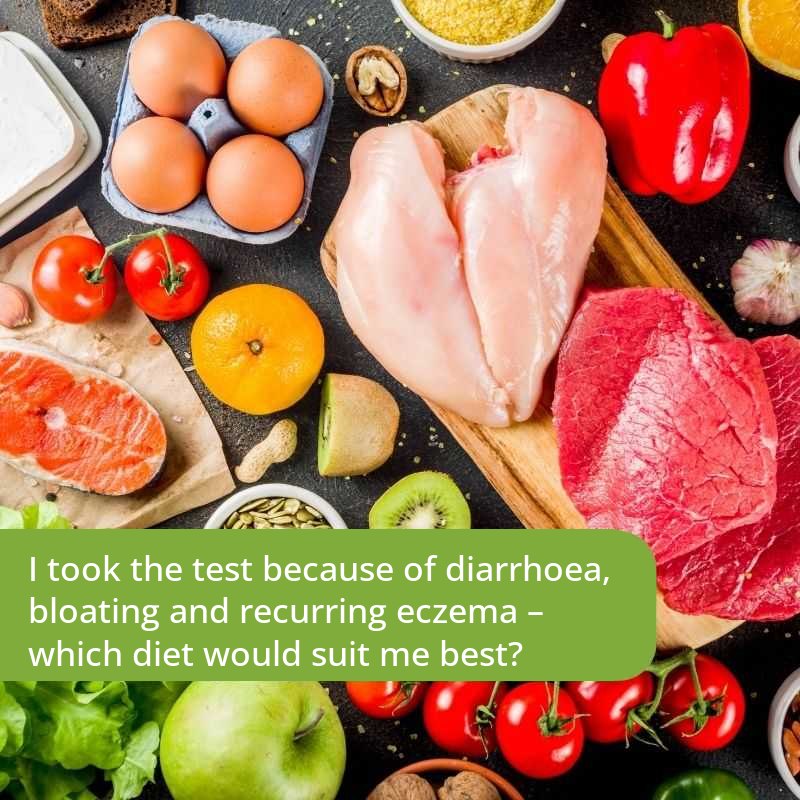
Dear Doctor, We have spoken before, about my little daughter's test report. Fortunately, thanks to the diet her eczema has become completely symptom-free. Now I am asking for your help with my own test report. I attach my test results and kindly ask for your help: which diet would suit me best? I requested the test mainly because of my abdominal complaints – diarrhoea, bloating, unpleasant abdominal symptoms – and my repeatedly recurring eczema.
You can read more about the possible causes of skin symptoms, and whether diet may play a part in them, on our skin problems page.
Answer: I am very glad that your daughter's complaints have stopped; I recommend that you follow a diet similar to hers.
In food intolerance with many positive results, we consider it necessary to eliminate foods with a value above 60 for at least three months. For foods in the borderline range, it is enough to eat them less often, 2–3 times a week.
Based on your result, the foods to be eliminated are: cow's milk, egg white, mackerel, gliadin-containing cereals, celery, agar-agar, kola nut, brewer's yeast.
In your case, we recommend a tissue transglutaminase test, especially if your complaints match the typical symptoms of coeliac disease. Coeliac disease comes with diarrhoea and weight loss. Based on your gliadin value we can establish gluten sensitivity; its extent will be clarified by the recommended test. This test is suitable for screening for coeliac disease. If you do not have coeliac disease, it is enough to leave out gluten-containing foods for three months. In the case of the autoimmune disease (coeliac disease), a gluten-free diet must be followed for life.
Based on your gliadin intolerance value, you should avoid the following gliadin-containing cereals: wheat, rye, barley, oats, kamut, spelt and durum wheat, as well as their flours, meals and flaked versions. Suitable alternatives are the following: millet, tapioca, pumpkin seed, psyllium husk, carob seed, maize, soya, almond, rice and buckwheat flour, etc.
Because of your milk intolerance, you can have plant-based rice, soya or almond milk instead of milk and dairy products. You can also make nut milk at home. These products can be drunk at breakfast and used to make vegetable stews, soups, sauces, muesli, porridges and creams. You will also find plant-based cheese in the shops. Because of your positive casein value, the milk or products of other animals cannot be eaten either. Lactose-free milk is not suitable: it does not contain lactose (milk sugar), but it does contain casein. The following terms on food packaging indicate a milk ingredient, so eating the product is not recommended: butter, skimmed milk powder, sour cream, milk powder, cream, milk drink, cheeses, butter oil, margarine, milk chocolate, low-fat milk drink, whey, whey powder, whey drink, sweet whey powder, whey protein concentrate, calcium caseinate, sodium caseinate, casein, hydrolysed casein, lactoferrin, lactalbumin, lactoglobulin.
Milk protein may be present in meat products and bakery and confectionery products; milk can be found in practically every food group, right up to convenience products, as a basic ingredient, an additive, or a contaminant that gets in during production and distribution. Milk may be found in cakes, bread, pizza, gravy, instant mashed potato, cream soups, ready meals, processed meats, sausages, black and white puddings, frankfurters, packaged snacks, chocolate, sweets, custard sauce, floating islands, puddings, dressings, ice cream and creams. You should reduce or leave out these foods wherever possible.
Egg white sensitivity applies only to the white; you can eat egg yolk. Instead of egg white, plant-based milk, apple purée, banana purée, boiled mashed potato, tomato purée, oil or Loprofin egg replacer powder can be used, depending on the dish.
Among nuts and seeds, eat pistachios a little less often, but you can freely eat the others. These ensure an adequate calcium intake.
Among vegetables, only celery is affected; do not eat it during the elimination diet. Instead of cold cuts, home-cooked meat dishes are much healthier and more reliable. Kola nut is found in shop-bought cakes, biscuits and soft drinks. When used as a natural sweetener, it does not have to be listed on the label.
Agar-agar (E 406) is a gelling agent found in aspic products (confectionery, jam, preserved fruit, cold cuts, yoghurt). Using home-made ingredients is more suitable.
Because of your positive brewer's yeast result, avoiding fermented drinks (wine, beer) is recommended. Because of your daughter, I assume you use bicarbonate of soda or yeast-free baking powder; this is suitable for you and the whole family too.
A course of probiotics that supports the regeneration of the intestinal lining speeds up recovery. A food supplement with a high bacterial count that contains both prebiotics and probiotics is a suitable choice. Food intolerance is not the same as food allergy; the symptoms of intolerance are prolonged and less distinctive. In food intolerance, after keeping to the three-month diet, the positive foods can be gradually reintroduced (eat a small portion, then take a 3–5 day break). During the diet and the reintroduction, it is important to monitor changes in your symptoms and keep a diet diary.

Don't just get the school bag ready
Starting school is not only about new exercise books and a changed daily routine but also about reorganising family meals. The FOODTEST Children's pac...

IBS and food intolerance: can diet help?
Several factors may lie behind irritable bowel syndrome, and the role of diet may also come up. The article explains in plain terms how certain foods...

Do you have to give up tasty food with a food intolerance?
Free-from or diet cooking does not mean going without: with the right ingredients and tricks, you can make tasty, varied dishes at home too.
FOODTEST newsletter
Food intolerance tips and recipes by email
Practical diet tips and recipes, straight to your inbox.