Author: Dr Károly Krkos
Hypersensitivity, idiosyncrasy, pseudoallergy
Hypersensitivity, i.e. the body's unusual reaction to various substances (foods, plants, pollens, medicines, etc.), can be traced back to many causes: some have a toxicological or biochemical background, while others are linked to activation of the immune system. Some of the reactions triggered by medicines and various chemical substances (e.g. preservatives, colourings, artificial flavour enhancers) follow from the pharmacological effects of the agent and are predictable; these are type “A” (Augmented) adverse effects – e.g. salicylates may cause stomach complaints). Others develop unpredictably, in certain individuals: type “B” (Bizarre) adverse effects – these include idiosyncratic processes, pseudoallergy and various reactions with an immunological background1. Gell and Coombs classified the latter into 4 groups3,4,12,20.
- Type I immune-mediated hypersensitivity, or anaphylactic reaction, is allergy: IgE antibodies are produced against the target molecule. These bind to the high-affinity IgE receptors (FcRI) on the surface of mast cells. This part of the process (sensitisation) takes 1–2 weeks. After that, entry of even a minimal amount of allergen is enough to activate the mast cells by cross-linking the IgE molecules bound to their surface, and within minutes to 1–2 hours characteristic skin, mucosal and digestive symptoms, and in severe cases respiratory and circulatory symptoms, develop.
- Type II comprises cytolytic reactions (i.e. those involving the breakdown of certain cells). Here the antibodies produced cause the breakdown of the attacked cells either by activating the complement system or by binding to the surface of the target cells, with the involvement of certain lymphocytes (e.g. NK cells). Examples include penicillin-induced haemolytic anaemia (anaemia due to the breakdown of red blood cells), quinidine-induced thrombocytopenic purpura (a disease with tiny skin haemorrhages due to the breakdown of platelets) and sulfonamide-induced granulocytopenia (a condition with a reduced number of certain white blood cells). These conditions resolve within a few months once the trigger is avoided.
- Type III is the Arthus reaction or serum sickness. Here the IgG antibodies produced form immune complexes with the antigen, which are deposited on the inner wall of small blood vessels (in the endothelium) and, through complement activation, start inflammatory processes; many cytokines/chemokines are released and various white blood cells migrate to the site, resulting in skin eruptions, joint pain/arthritis, enlarged lymph nodes and fever. Many medicines (including antibiotics) can trigger such a reaction. The condition improves considerably within 1–2 weeks after the triggering substance is avoided.
- Type IV is delayed hypersensitivity. Cells (T lymphocytes and macrophages), not antibody production, play a role in its development. Such a reaction is triggered, for example, by urushiol, found in the sap of poison ivy species (Toxicodendron)11.
The definition of idiosyncrasy is not clear-cut, but it is in any case an adverse effect that differs from the pharmacological effects of the agent, develops only in certain individuals and unpredictably (type “B”), and is not infrequently life-threatening2. According to Seth's Textbook of Pharmacology, idiosyncrasy is an unusual response, or an extreme form of a known reaction, to the usual dose of an agent in a small number of individuals3. Perhaps the simplest and most concise definition is found in Goodman and Gilman's handbook “The Pharmacological Basis of Therapeutics”: idiosyncrasy is an abnormal reactivity to a chemical agent that is peculiar to a given individual4. The uncertainty of the definition is due to the diversity of the processes underlying the phenomenon. More and more types of reaction with a hereditary background have been uncovered, some based on biochemical and others on immunological abnormalities. On this basis, the processes falling under idiosyncrasy can be grouped
- by pathological mechanism:
- HLA I- and
- HLA II-associated reactions,
- HLA-dependent reactions modified by other factors,
- processes involving mitochondrial damage,
- processes associated with viral infection,
- processes caused by the immunological effect of an agent that is directly immunoreactive, or
- becomes immunoreactive by binding to a protein, or
- alters the reactivity of a protein.
- By clinical symptoms, they may be
- localised to the skin,
- involving liver damage,
- causing a disease of the haematopoietic system,
- forms leading to an autoimmune condition2,5-10.
The type I reaction is a direct consequence of mast cell activation (the release of histamine and many other bioactive substances), triggered by the interaction of the allergen with allergen-specific IgE molecules bound to the high-affinity FcεRI receptor. In an earlier summary (“The role of mast cells in functional gastrointestinal disorders”) we already mentioned that mast cell activation can be induced not only by IgE antibodies produced against an allergen. Many other receptors (e.g. complement receptors) are also found on their surface. Furthermore, the release not only of the contents of mast cell granules but also of other bioactive substances produced in mast cells (and other cells) contributes significantly to the process.
Anaphylaxis-like symptom complexes caused by non-IgE-triggered mast cell activation, as well as conditions resembling a type I reaction that are not based on an immune response, have been given the name pseudoallergy13,14,15,18.
The clinical symptoms of pseudoallergy closely resemble those of allergy and of the anaphylactoid reaction. The main differences are that pseudoallergy can cause violent, even life-threatening symptoms at the very first encounter with the substance, i.e. the first phase of the allergic process, sensitisation, does not take place, and the IgE production typical of allergy is absent12,3,14. It follows from the mechanism of the condition that it cannot be confirmed either by a blood IgE test or by a skin prick test12.
Pseudoallergy can be triggered by several mechanisms.
- Agents that directly cause the release of bioactive substances: opiates (primarily codeine and morphine) lead to the release of bioactive substances stored in mast cells via the μ-opioid receptors also present on mast cells14. Vitamin K injection (probably its solvent) and rocuronium cause the release of substances stored in mast cells by acting on the mast cell MRGPRX2 (Mas-Related G-Protein coupled Receptor X2) receptor14,17. Iodinated contrast media can also trigger direct mast cell activation13,19.
- Mast cell degranulation can also be triggered by the anaphylatoxins (C3a and C5a) produced during activation of the complement system (mast cells carry C3a and C5a receptors on their surface). This complement activation-related pseudoallergy (CARPA) can be induced by liposomal and micellar medicines (e.g. doxorubicin, daunorubicin, amphotericin B; cyclosporin)12,14,21.
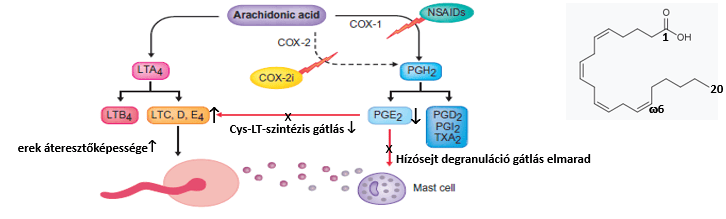
- Non-steroidal anti-inflammatory drugs (NSAIDs), by inhibiting cyclo-oxygenase (COX), which plays an important role in arachidonic acid (eicosanoid) metabolism, shift the prostanoid/leukotriene ratio in favour of leukotrienes.
Figure 1: Simplified eicosanoid metabolism (based on reference 13)
arachidonic acid
As a result of COX1 inhibition, arachidonic acid metabolism shifts towards the lipoxygenase pathway, so the level of cysteinyl leukotrienes rises and the level of prostaglandin E2 falls. The latter leads to increased cysteinyl leukotriene synthesis and reduced inhibition of mast cell degranulation, which favours the formation of tissue swelling (oedema)12,13,14.
- Processes involving activation of the kallikrein-kinin system can lead to angioedema (swelling of the deeper layers of the skin and mucous membranes)12,13. The bradykinin produced plays a key role in this process. C1-INH (C1 esterase inhibitor), the main regulator of classical complement activation, is also an inhibitor of plasma kallikrein and of the activation of coagulation factors XI and XII. Inherited or acquired deficiency or dysfunction of C1-INH can therefore lead to excessive bradykinin production and the development of angioedema13. Angiotensin-converting enzyme (ACE) is needed to break down bradykinin. This is why ACE inhibitor therapy can also trigger this severe process in some individuals13,18.
Pseudoallergy can be caused not only by medicines but also by food additives (e.g. benzoates, tartrazine) and by low-molecular-weight aromatic compounds occurring in foods/drinks (e.g. in tomatoes, white wines, herbs)13,15,22. Food-induced pseudoallergy has been confirmed in many cases in the following conditions:
- chronic urticaria (itchy wheals on the skin that persist for more than 6 weeks or recur repeatedly for no apparent reason)
- recurrent angioedema
- non-allergic asthma (intrinsic bronchial asthma)15
In addition, it may be associated with atopic dermatitis and gastrointestinal diseases (but this has not been clearly proven).
An autologous serum skin test (ASST) can be used to screen for processes with an autoimmune background that cause similar complaints23.
Chronic urticaria is primarily the condition in which it is advisable to investigate the presence of pseudoallergy. According to the literature, its prevalence in this patient group is 1–50%15,22. When no other trigger can be confirmed in the conditions mentioned above, the patient is put on a low-pseudoallergen diet (Table 1).
Table 1: Example of a low-pseudoallergen diet (based on articles 15 and 22)
| Generally not allowed | Any food that contains flavourings, preservatives, colourings or antioxidants (practically all industrially produced foods available in shops). | |
|---|---|---|
| Type of food | Allowed | Not allowed |
| Staple foods | Preservative-free bread, bread rolls, semolina, millet, potatoes, rice, egg-free durum wheat pasta, pancakes containing only rice and salt | All other foods (e.g. other pasta, egg pasta, pastries and cakes, chips) |
| Fats | Butter, vegetable oils | All other fats (e.g. margarine, mayonnaise, etc.) |
| Dairy products | Fresh milk, fresh carrageenan-free cream, soured milk, plain yoghurt, unspiced cream cheese, small amounts of young Gouda | All other dairy products |
| Meat | Fresh meat, unseasoned freshly minced meat, home-made cold cuts | All industrially produced meat products, eggs, fish, seafood |
| Vegetables | All vegetables except those not allowed (e.g. lettuce, carrots, courgettes, Brussels sprouts, cabbage, Chinese cabbage, broccoli, asparagus) | Artichokes, peas, rhubarb, spinach, tomatoes, potato products, olives, peppers |
| Fruit | None allowed | All fruit and fruit products (dried fruit, compotes, juices, etc.) |
| Spices | Salt, sugar, chives, onions | All other spices, garlic, garden herbs |
| Sweeteners | None allowed | Chewing gum, artificial sweeteners and foods containing them |
| Drinks | Milk, mineral water, coffee, unflavoured black tea | All other drinks, including herbal teas and alcoholic drinks |
| Spreads and toppings | Honey and the products listed above | Products not listed |
The diet must provide adequate macro- and micronutrients. As it contains no fruit, fruit must be replaced with vegetables. In severe cases a potato-and-rice diet is recommended. For a few days this monotonous diet does no harm to the body, although many patients cannot keep to a rice-and-potato diet for a whole week. Patients must keep an accurate food diary and also record their symptoms using what is known as the urticaria score (Table 2).
Table: The urticaria score (based on articles 15 and 22)
| Score | Explanation | |
|---|---|---|
| Assessment of wheals (severity) – objective symptoms | 0 | No wheals |
| 1 | Few (<10) wheals | |
| 2 | Moderately severe (separate, ³10) | |
| 3 | Many wheals (dense, merging) | |
| Assessment of itching – subjective symptoms | 0 | No itching |
| 1 | Slightly itchy | |
| 2 | Moderately itchy | |
| 3 | Very itchy |
To help participants keep going, antihistamine tablets may be given during the first 10–14 days; after that the medication must be stopped and the course of symptoms monitored while the diet continues. If the diet brings no improvement, the patient is switched to an oligoallergenic diet (Table 3).
Table: Oligoallergenic diet (based on article 15)
| Group | Food |
|---|---|
| Cereals | rice |
| Meat | lamb, turkey |
| Vegetables | cauliflower, broccoli, cucumber |
| Oils | refined vegetable oils, dairy-free margarine |
| Drinks | mineral water, black tea |
| Spices | salt, sugar |
If the diet has brought significant improvement, or the symptoms have perhaps disappeared completely, a challenge may follow. This may only ever be carried out under hospital supervision (so that a severe, anaphylactic reaction, should it occur, can be treated immediately), taking into account that no food allergy (IgE) exists to the planned components. Antihistamines must be stopped 1 week and steroid treatment 3 weeks before the challenge. A challenge with individual food additives alone (colourings, preservatives, antioxidants) is not reproducible, so after a successful low-pseudoallergen diet the challenge must be carried out with a “super food” (Table 4). Hospital supervision for 16–24 hours is required after the challenge. The day 2 challenge should be carried out if the day 1 challenge was negative15.
Table 4: Example of a challenge protocol (based on article 15)
| Day 1 | |
|---|---|
| Breakfast | Breakfast: Coffee or tea with artificial sweetener (cyclamate and saccharin), condensed milk or milky coffee, diet yoghurt with fruit and muesli (cornflakes, almonds, hazelnuts, walnuts, cashews, peanuts, sunflower seeds, sesame seeds, linseed, pumpkin seeds, raisins, prunes (with sorbic acid*), fruit preserved with sulphite (apricots, peaches, pears, apple rings), orange juice |
| Snacks during the day | Snacks during the day: 6 strawberry-flavoured marshmallows (with flavouring and colouring), 2 flavoured chilled desserts (ice cream, cream, mousse, etc.), 2 milk caramels (with flavouring), 1 butter, peanut and cereal bar, 2 pieces of chewing gum (with artificial sweetener and antioxidant), 30 g paprika crisps, 1 bar of chocolate, 1 serving of sports drink (with colouring and preservative), 1 glass of diet cola, 1 apple, 1 banana. |
| Lunch | Lunch:Spicy pizza with tomato sauce, oregano, pepper, salt, garlic, paprika, spinach, tuna in oil, salmon, prawns (with preservative and artificial colouring), black olives, Emmental cheese, spinach, 0.5 l beer, 0.33 l diet cola. |
| Between meals | Between meals: Coffee or tea (with artificial sweetener), condensed milk or coffee creamer, 3 sugared pancakes (with artificial flavouring and colouring) |
| Dinner | Dinner: Tea with artificial sweetener, 2 slices of wholemeal sesame bread, 2 slices of cheese, two servings of reduced-fat margarine (with preservative), 2 servings of diet jam, 1 serving of tuna salad with thickener and flavouring) |
| Day 2 | |
| Breakfast | Breakfast: Coffee or tea with artificial sweetener tablets, condensed milk or coffee creamer, 2 wholemeal bread rolls, low-fat margarine, 1 serving of peanut butter, Maasdam cheese. |
| Snacks during the day | Snacks during the day: 1 Kinder chocolate bar, 2 pieces of spearmint chewing gum containing sweetener and antioxidant, 2 fruit-flavoured chewy sweets (with flavouring and artificial colouring), 1 coconut bar, diet cola, multivitamin juice, kiwi, orange. |
| Lunch | Lunch: Waldorf salad (containing mayonnaise, celery, pineapple and walnuts), potatoes preserved with sulphite, red or green jelly (with artificial colouring), vanilla cream sprinkled with sugar coloured with artificial colouring, 250 ml red wine (for adults), 200 ml apple juice (for children) |
| Between meals | Between meals: Coffee or tea. |
| Dinner | Dinner: Seasonal salad, leaf salad, vegetable salad, carrots, cucumber, peppers, Thousand Island dressing, herring salad (preserved with sodium sorbate and sodium benzoate, with stabiliser), sunflower seed bread, cheese slices, boiled ham, low-fat margarine (with preservative), tea. |
| Day 1 – food additive test | |
| Test | Food additives given in capsules, or the same number of identical placebo capsules. |
| Food additives: | Colouring mixture (E100 curcumin, E120 carmine, E132 indigo carmine, E141 copper complexes of chlorophylls and chlorophyllins, E172 iron oxides and iron hydroxides, E102 tartrazine, E104 quinoline yellow, E110 sunset yellow, E122 azorubine, E123 amaranth, E124 ponceau 4R (cochineal red A), E127 erythrosine, E129 allura red, E131 patent blue, E133 brilliant blue FCF, E142 green S, E151 brilliant black – 5 mg of each); preservatives: sorbic acid 1000 mg, sodium benzoate, p-hydroxybenzoic acid – 1000 mg each, potassium bisulphite 300 mg, sodium nitrate 100 mg, sodium salicylate 1000 mg; antioxidants: butylated hydroxyanisole (BHA), butylated hydroxytoluene (BHT), propyl gallate, tocopherol, caffeic acid – 50 mg of each; artificial sweeteners: 200 mg aspartame, 100 mg acesulfame K, sodium saccharin – 40 mg, cyclamate 400 mg. |
| Day 2 – food additive test | |
| Test | Capsules containing the same amount of placebo or artificial food additives as on the previous day. |
* sorbic acid (E200) and sodium (E201), potassium (E202) and calcium (E203) sorbate: preservatives
If the patient's history clearly shows that, before the low-pseudoallergen diet, the patient with symptoms had been on a diet containing only few food additives and pseudoallergens, a correspondingly personalised challenge can be planned. If the two-day test did not give a positive result, a further two-day challenge is needed. If objective symptoms (urticaria or angioedema or both) have appeared, a change of diet is needed until the patient's symptoms improve significantly. To rule out food additives, an additive challenge follows (see table). If the additive mixture produced a significant reaction, the individual additives can be tested one at a time, step by step. If, in addition to or instead of urticaria and angioedema, other (respiratory, anaphylactoid) symptoms appear, further tests are needed with increasing doses of the suspected pseudoallergen, with intensive care back-up. If histamine sensitivity is suspected, a histamine challenge (0.75 mg/kg and 1.5 mg/kg body weight) should be carried out (unless contraindicated). In special cases a glutamate (4 g) challenge should be performed.
A double-blind challenge is also used to confirm sulphite sensitivity in asthmatic patients (with intensive care facilities available).
If, according to the patient's history, the reactions develop after physical exertion, the challenge test must be followed by 45–60 minutes of exercise (e.g. on a treadmill).
If gastrointestinal symptoms develop after the challenge, they are often not objective, so only a double-blind challenge can prove that the pseudoallergen caused the symptoms.
Blood pressure and pulse monitoring is required during the challenges.
If the pseudoallergen-rich diet caused objective symptoms, the ideal diet must be built up gradually after introducing the low-pseudoallergen diet and once the symptoms have decreased significantly. Reactions are monitored while one selected non-allowed food is added every 3 days. If the non-allowed component did not worsen the symptoms, it may be eaten; if it did, it remains excluded.
Reliably assessing the effect of a low-pseudoallergen diet is no simple task, as the study by M Magerl and colleagues22 shows.
To develop the ideal dietary management, the range of food intolerance investigations should also be extended to include ruling out/diagnosing pseudoallergy.
References
- D G Valler: Allergy, pseudoallergy, and non-allergy Br J Clin Pharmacol 2011, 71(5): 637-638; DOI:10.1111/j.1365-2125.2011.03976.x
- J Uetrecht & D J Naisbitt: Idiosyncratic Adverse Drug Reactions: Current Concepts, Pharmacol Rev. 2013 Apr, 65(2): 779–808; doi: 10.1124/pr.113.007450
- S D Seth, A Prakash: Adverse Drug Reactions (Chapter 6) in S D Seth, V Seth: Textbook of Pharmacology 3rd edition, ed by Elsevier 2009 (ISBN 978-81-312-1158-8), p: 1.48
- K C Osterhoudt, T M Penning in Goodman & Gilman’s: The Pharmacological Basis of Therapeutics, 12th edition, ed by Laurence Brunton 2011 (ISBN 978-0-07-176939-6), Section 1: General Principles, Chapter 4: Drug Toxicity and Poisoning, p.76
- J Adam, W J Pichler, D Yerly: Delayed drug hypersensitivity: models of T-cell stimulation, Br J Clin Pharmacol, . 2011 May; 71(5):701-707. doi: 10.1111/j.1365-2125.2010.03764.x.
- B Y-H Thong, T-C Tan: Epidemiology and risk factors for drug allergy, Br J Clin Pharmacol 2011, 71(5): 684-700; DOI:10.1111/j.1365-2125.2010.03774.x
- M Chaponda & M Pimohamed: Hyprersensitivity reactions to HIV therapy Br J Clin Pharmacol 2011, 71(5): 659-671; DOI:10.1111/j.1365-2125.2010.03784.x
- S R Knowles, J Uetrecht et al: Idiosyncratic drug reactions: the reactive metabolite syndromes, Lancet 2000, 356(9241): 1587-1591; https://doi.org/10.1016/S0140-6736(00)03137-8
- J Uetrecht: Idiosyncratic Drug Reactions: Current Understanding, Annu Rev Pharmacol Toxicol. 2007, 47: 513-539; doi: 10.1146/annurev.pharmtox.47.120505.105150
- B. K. Park, M. Pirmohamed & N. R. Kitteringham: Idiosyncratic drug reactions: a mechanistic evaluation of risk factors, Br. J. Clin. Pharmac. (1992), 34, 377-395
- M Gross, H Baer, H M Fales: Urushiols of Poisonous Anacardiaceae, Phytochemistry, 1975, 14: 2263-2266, doi: 10.1016/S0031-9422(00)91113-0
- P Bedőcs: Complement Activation Related Pseudoallergy and Its Animal Models PhD thesis Budapest, 2013. Semmelweis University (http://old.semmelweis.hu/wp-content/phd/phd_live/vedes/export/bedocspeter.d.pdf)
- C E H Grattan, E Borzova: Urticaria, Angioedema and Anaphylaxis 2019 Clinical Immunology 5th Edition Chapter 42: 585-600, DOI: 10.1016/B978-0-7020-6896-6.00042-9
- B Zhang, Q Li, C Shi, X Zhang: Drug-induced Pseudoallergy: A Review of the Causes and Mechanisms, Pharmacology 2018, 101:104-110, DOI: 10.1159/000479878
- I Reese, T Zuberbier et al.: Diagnostic approach for suspected pseudoallergic reaction to food ingredients JDDG 12009 Guidelines, DOI: 10.1111/j.1610-0387.2008.06894.x
- R A Simon: NSAIDs (including aspirin): Allergic and pseudoallergic reactions 2019 UpToDate, https://www.uptodate.com/contents/nsaids-including-aspirin-allergic-and-pseudoallergic-reactions
- C J Bansal, A S Bansal: Stress, pseudoallergerns, autoimmunity, infections and inflammation in chronic sponteneous urticaria Allergy, Asthma Clin Immunol 2019 15:56, https://doi.org/10.1186/s13223-019-0372-z
- A Frew: General principles of investigating and managing drug allergy Br J Clin Pharmacol 2011, 71(5): 642-646; DOI:10.1111/j.1365-2125.2011.03933.x
- N H Siddiqi: Contrast Medium Reactions_emedicine 2017, https://emedicine.medscape.com/article/422855
- R Patterson, M S Dykewicz et al.: Classification of Immediate type, Life-thretening Allergic or Pseudoallergic Reactions, Chest, 1990, 96(2): 257-259
- Zs Patkó, J Szebeni: Blood cell changes in complement activation-related pseudoallergy Eur J Nanomed 2015 7(3): 233-244, DOI 10.1515/ejnm-2015-0021
- M Magerl, D Pisarevskaja et al.: Effects of pseudoallergen-free diet on chronic spontaneous urticaria: a prospective trial, Allergy 2010 65: 78-83, DOI:10.1111/j.1398-9995.2009.02130.x
- R A Sabroe, C E H Grattan et al.:The autologous serum skin test_ a screening test for autoantibodies in chronic idiopathic urticaria, Br J Dermatology 1999, 140:446-452, https://doi.org/10.1046/j.1365-2133.1999.02707.x
SIBO and food intolerances: is food necessarily to blame?
Bloating after milk, bread or onions? The way the digestive system works may also play a role behind these symptoms. Dr Anikó Hovanecz’s article expla...

A corporate health programme in practice – the SFC CEO’s experience
What does caring for employees and their family members mean for a company leader? Through his personal experience, Gábor Horváth, CEO of SFC, explain...

Don't just get the school bag ready
Starting school is not only about new exercise books and a changed daily routine but also about reorganising family meals. The FOODTEST Children's pac...