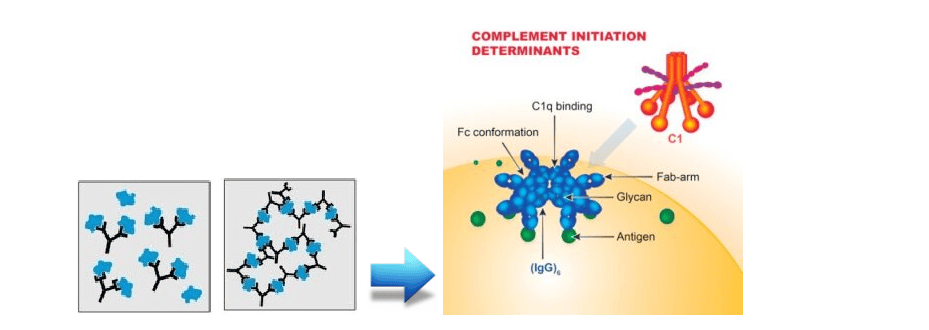
The production of antibodies against food components and the formation of immune complexes is a natural process; such immune complexes (ICs) can also be detected in the blood of healthy people. The immune system removes these complexes (by phagocytosis) as long as they are not formed in large quantities1. When few antibodies have been produced relative to the amount of antigen, small ICs are formed that are easy to remove (antigen excess). When a larger (equivalent) amount of antibody is produced, it forms large ICs with the antigen, which are difficult to remove and can activate the classical pathway of the complement system (which begins with the binding of the C1q component), thereby triggering inflammatory processes2,3.
You can read more about the possible causes of weight problems, and whether food sensitivity may play a part, on our weight problems page.
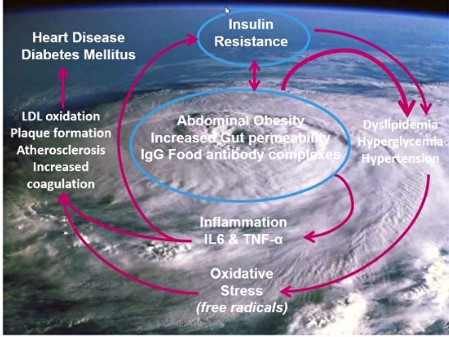
If intestinal permeability increases and larger amounts of insufficiently digested food enter the body, large amounts of antibody and many large ICs are formed, which leads to systemic chronic inflammation (SCI) and the development of chronic diseases4.

Low-grade inflammation can be demonstrated in obesity. Inflammatory markers such as C-reactive protein (CRP) correlate with the severity of obesity and insulin resistance, and normalise with weight loss5. In obese children, a close correlation has been shown between CRP and the intima-media thickness (IMT) of the common carotid arteries, which indicates a precursor state of atherosclerosis6. According to the study by M. Wilders-Truschnig and colleagues7, the level of IgG produced against food components is significantly higher in obese children than in children of normal weight. Anti-food IgG showed a close association with low-grade inflammation (CRP level) and with the IMT of the common carotid artery, in both obese and healthy children. The passage of larger molecules through the intestinal wall triggers low-grade chronic inflammation, which is presumably the underlying cause of the development of type 2 diabetes and atherosclerosis. Food-specific IgG is therefore very likely to play a role in the development of obesity and atherosclerosis. The study supports the link between food-specific IgG, obesity, systemic inflammation and the early development of atherosclerosis.
The relationship between inflammation and anti-food IgG
Another study, of obese adults, examined the effect of an elimination diet introduced on the basis of anti-food IgG testing8. With the dietary change, a significant reduction in body weight, BMI, waist-to-hip ratio and serum triglyceride levels was observed compared with those not on the diet. In addition, symptoms of reflux, IBS, chronic fatigue and headache eased in the elimination diet group. In a study analysing a larger obese population9, BMI, waist-to-hip ratio, resting blood pressure and quality of life (based on the SF-36 questionnaire) were checked 30, 60 and 90 days after the introduction of the elimination diet. A significant improvement was observed after the 90-day diet both in resting diastolic blood pressure and in the other parameters mentioned, as well as in quality of life.

References
- Paganelli, R. J. Levinsky, D. J. Atherton: Clin exp Immunol 1981, 46:44-53
- L. Dunkelberger, W. C. Song: Cell Research 2010, 20:34-50, doi: 10.1038/cr.2009.139
- Wang, R. N. deJong et al.: Mulecular Cell 2016, 63:135-145, http://dx.doi.org/10.1016/j.molcel.2016.05.016
- Furman, J. Campisi et al.: Nat Med 2019, 25(12):1822-1832, doi:10.1038/s41591-019-0675-0
- G. Cook, M. A. Mendall et al.: Atherosclerosis 2000, 149:139-150
- Mangge, K. Schauenstein et al.: Exp Clin Endocrinol Diabetes 2004, 112:378-382
- Wilders-Truschnig, H. Mannge et al.: Exp Clin Endocrinol Diabetes 2008, 116:241-245, doi: 10.1055/s-2007-993165
- Y. Onmus, E. C. Cakirca, A. Salklamaz: Journal of Food and Nutrition Research 2016, 4(1):1-5, DOI:10.12691/jfnr-4-1-1
- E. Lewis, J. M. Woolger et al.: J Obes Weig los Ther 2012, 2:1, http://dx.doi.org/10.4172/2165-7904.1000112
SIBO and food intolerances: is food necessarily to blame?
Bloating after milk, bread or onions? The way the digestive system works may also play a role behind these symptoms. Dr Anikó Hovanecz’s article expla...
A corporate health programme in practice – the SFC CEO’s experience
What does caring for employees and their family members mean for a company leader? Through his personal experience, Gábor Horváth, CEO of SFC, explain...

Don't just get the school bag ready
Starting school is not only about new exercise books and a changed daily routine but also about reorganising family meals. The FOODTEST Children's pac...