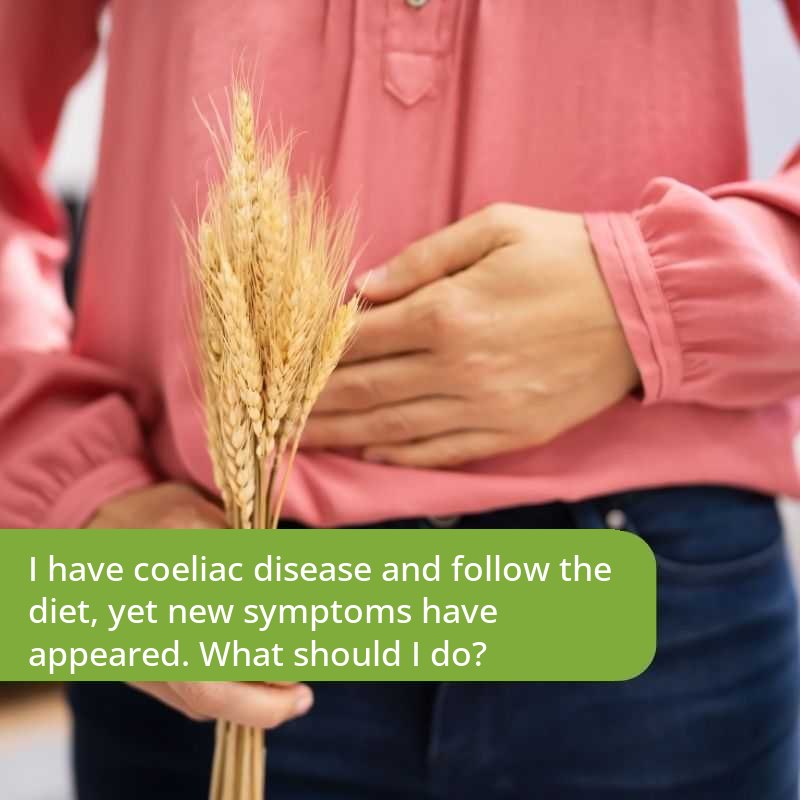
A year ago I found out that I have coeliac disease. I follow the diet, but my stomach still hurts. My other complaints: I have spots on my face, which was not typical for me before, the corners of my mouth often crack, and I cannot put on weight even though I eat quite a lot. I have had the FOODTEST 200+ food intolerance test done. What else do you think the problem could be?
Answer: The symptoms of food intolerance are protracted and less distinctive; they do not appear immediately or cause a violent reaction, as we see with a food allergy. For allergy we measure IgE levels, for intolerance the amount of IgG antibodies. With food intolerance, the positive foods can in practice be gradually reintroduced after the three-month diet, but! with diagnosed coeliac disease the gluten-free diet is for life. What is more, with coeliac disease it can take 1–2 years for the gut to regenerate.
The development of food intolerance depends on several factors. It is linked to dietary habits, dietary variety and the condition of the digestive system.
Your food intolerance test report looks very good: gliadin is negative. The following foods show a positive result: barley, wheat, maize, cashew nut, amaranth, kola nut.
The positive result for wheat may be caused by using gluten-free wheat starch. The value for wheat and other cereals is not the same as gliadin sensitivity. For solubility reasons, gliadin is extracted beforehand from cereals containing gliadin. Gliadin is soluble in alcohol, while the other proteins are water-soluble. These foods are then present in the body only with their other proteins. In this case you are sensitive to a different type of wheat protein (alpha-amylase inhibitor).
The value of 80 for maize is explained if you use it more often as a gluten-free flour. For pasta, choose rice pasta, pasta made from buckwheat, millet or sorghum flour, or NoCarb pasta. These pastas are free from gluten, maize and wheat. It is worth looking for these products specifically in food allergy shops.
Try to vary the gluten-free flours you use for cooking. You already know these very well: rice, brown rice, buckwheat, soya, millet, flaxseed, almond, hazelnut, coconut and psyllium husk flour, potato starch, green banana flour, quinoa flour, etc.
When making bread and baked goods, leave out maize flour; use soya, rice and buckwheat flour as a base, and it is worth adding various seeds (flaxseed, chia seeds). To replace gluten, you can use xanthan gum, guar gum, pectin or locust bean gum, and psyllium husk is also an excellent gelling and binding agent.
You can find bread recipes at www.mindenmentes.hu. You can find recipes at www.etelallergia.hu and, for example, in the Springmed publication Lisztérzékenyek kézikönyve [Handbook for coeliacs].
Amaranth seed and flour should be avoided. Oilseeds with negative results are recommended for calcium intake.
Kola nut is found in ready-made cakes, biscuits and soft drinks.
Because of the value of 38 for brewer's yeast, fermented drinks (wine, beer) should be avoided. Avoid using vinegar and wine vinegar. There may also be yeast on the surface of dried fruit, so avoid these for the time being. Spice mixes and soup powders may also contain yeast, so it is worth reading their ingredients.
It is worth seeing your gastroenterologist about your complaints, who can order further tests. This may possibly be refractory coeliac disease. Sores at the corners of the mouth may point to Duhring's disease (dermatitis herpetiformis), which is also caused by gluten. First of all, it needs to be checked whether gluten is getting into your diet as a contaminant.
Bloating can be caused by lactose intolerance or fructose intolerance, which are worth investigating. So I suggest you see your doctor.
Alongside the diet, the healing process is supported by restoring the integrity of the intestinal lining with probiotic preparations.
How to reintroduce the positive foods
As the intestinal villi regenerate and as a result of the elimination diet, the reactive foods can usually be eaten again.
Developing a new intolerance can be avoided by following a diet built on varied ingredients and seasonality.
We recommend starting reintroduction with the affected food that has the lowest value. Only one food should be reintroduced at a time; this way you can tell whether digesting that food no longer causes complaints.

Don't just get the school bag ready
Starting school is not only about new exercise books and a changed daily routine but also about reorganising family meals. The FOODTEST Children's pac...
IBS and food intolerance: can diet help?
Several factors may lie behind irritable bowel syndrome, and the role of diet may also come up. The article explains in plain terms how certain foods...
Do you have to give up tasty food with a food intolerance?
Free-from or diet cooking does not mean going without: with the right ingredients and tricks, you can make tasty, varied dishes at home too.
Free download (PDF)
Elimination starter kit
Leaving foods out and bringing them back, step by step, without your plate going empty.