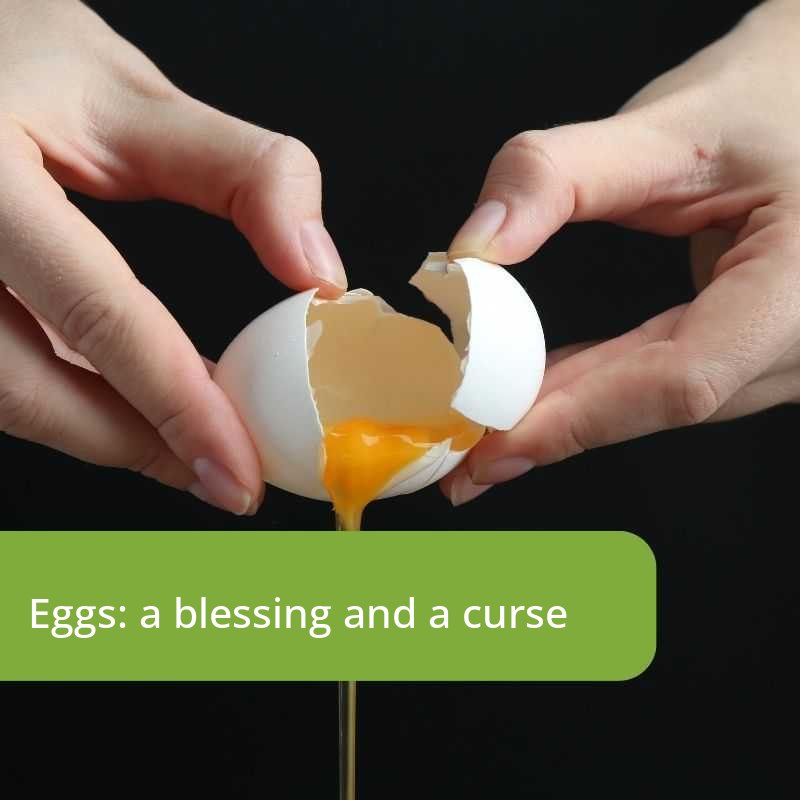
After breast milk, the egg is the most perfect food, yet it is one of the most common allergens!
Since the dawn of humankind, eggs have been one of the most important sources of food. They were easier to obtain than meat, and their nutritional value, in terms of protein and fat content, rivals that of meat. Hen’s eggs are the most widespread, but duck, goose and quail eggs are also used more and more often. In terms of nutrient content there is no great difference between the eggs of different poultry, but it certainly matters what kind of farming they come from!
Many beliefs and customs are associated with eggs, even in folk religion. These are mostly linked to fertility, prosperity, gift-giving, luck, driving away spirits or lifting curses.
It is a fact that eggs are very versatile and contain many vitamins and trace elements: they are significant sources of vitamins A, B2, D and E, and of carotene. A good-quality egg yolk contains one third of an adult’s daily vitamin A requirement, and its vitamin D content is second only to cod liver. They also contain large amounts of selenium, zinc, iodine, niacin, pantothenic acid, folate, phosphorus, iron, choline and biotin.
Their vitamin D content contributes to the maintenance of normal bones, and their vitamin B2 content to the maintenance of normal vision.
After breast milk, the egg is the most perfect food, yet it causes problems for many people! Eggs, and especially egg white, are one of the most common allergens!
Egg allergy mainly affects children; fortunately most of them grow out of it by the age of 10, but some people have to give up eggs for life. There are no exact figures, but around 0.5–1% of people may be allergic to eggs.
The test can be done for children from the age of 2; you can read more about the package put together for children here.
What causes egg allergy?
Eggs contain 40 different proteins, some of which do not break down even when heated. It is mostly this protein that causes problems both for people with an allergy and for those with a sensitivity. At the same time, the two problems must not be confused! With a sensitivity, many people are helped by leaving egg dishes out for a while under professional guidance and then reintroducing them gradually. An egg allergy, however, is a medical matter: if you suspect one, see an allergist and do not try reintroducing eggs at home.
What complaints can it cause?
In young children it mainly causes eczema, but it can also cause recurring respiratory complaints. In addition, abdominal complaints, bloating, diarrhoea and rashes may occur, or, in the case of a severe allergic reaction, numbness around the mouth, breathing difficulties and vomiting.
Egg substitutes: linseed flour, psyllium husk. By soaking these, you can make an egg-replacement paste in a few minutes; of course, this can only be used as a binding agent for baking and cooking – it will never become scrambled eggs.
You also need to be very careful with ready-made foods, since bakery products, breads, ragouts, pasta, cakes, cream fillings and ice creams are very likely to contain egg white. It is always worth reading the ingredients list carefully; the following may indicate egg white: albumin, egg (egg yolk, egg white, egg powder, dried egg), egg substitutes, egg liqueur, globulin, lecithin, lysozyme, mayonnaise, ovalbumin, ovovitellin, meringue.
Once you have completed the elimination diet and want to reintroduce eggs into your diet gradually, it is worth looking for the “cleanest” eggs possible. It is an unspoken parallel, yet a reality, that the eggs of caged hens kept for so-called industrial production may contain far more irritants, due to medicated feed, than the eggs of free-range hens. This is also why a uniform labelling system was created, which is practically very similar worldwide.
A little help in understanding the code on eggs, with a specific example:
3HU22103471
3: egg from caged hens
HU: egg from Hungary
22103471: farm identification number
The first digit is the most important! It refers to the conditions in which the hens are kept; it is followed by the country code and then the farm identification number.
0: organic farming – indicates eggs from (organic) farming, from free-range hens fed with organic feed.
1: free range – indicates farmyard free-range eggs; it cannot be ruled out that the hens were given feed and medication when needed
2: alternative system – or deep-litter (barn) system: the hens are housed in a large hall and have some limited room to move; these animals may also have received medication and feed
3: caged hens – (this hardly needs explaining) crowded animals, treated with feed and medication
In shops, eggs coded 3 and 2 are the most common. Eggs coded 0 can be found in some places and at organic markets. Eggs coded 1, however, are as rare as hen’s teeth; these are the real farmhouse eggs, mostly found at markets. Still, it is worth being a little more careful when buying eggs, because the more medication and feed a hen consumes, the greater the chance that derivatives of the chemicals are also present in its eggs.

Don't just get the school bag ready
Starting school is not only about new exercise books and a changed daily routine but also about reorganising family meals. The FOODTEST Children's pac...
IBS and food intolerance: can diet help?
Several factors may lie behind irritable bowel syndrome, and the role of diet may also come up. The article explains in plain terms how certain foods...

Do you have to give up tasty food with a food intolerance?
Free-from or diet cooking does not mean going without: with the right ingredients and tricks, you can make tasty, varied dishes at home too.
Free download (PDF)
Elimination starter kit
Leaving foods out and bringing them back, step by step, without your plate going empty.