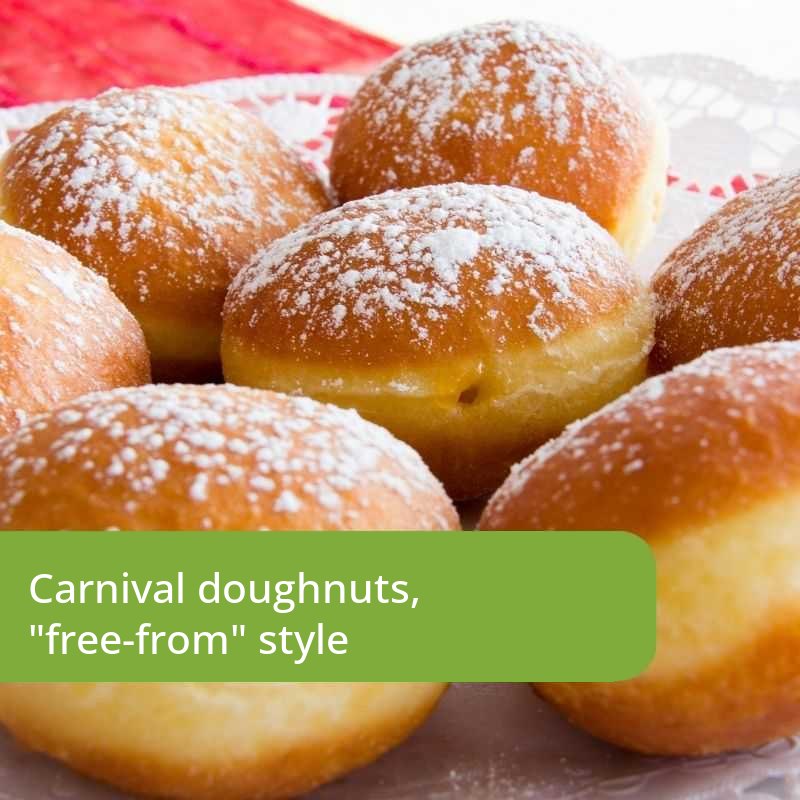
Going by my childhood memories, my grandmother's unrivalled doughnuts, made the "ribboned" way and served with homemade apricot jam, are perhaps heaven itself. Their taste and shape are impossible to imitate; even with wheat flour, farm eggs and milk they take a lot of practice and patience.
But what if we cannot eat wheat flour, or perhaps milk and eggs either? One thing is certain: we never give up, even if they will not be as beautiful as in our childhood.
Our first task is to choose a suitable flour. This can come from your own ideas, but also from a ready-mixed convenience product. If you choose the latter, read the ingredients carefully, so that the list does not include anything you cannot eat.
The choice is huge, and the market is increasingly ready and waiting for us to open our wallets. I chose Zellei Tündi's flour blend. Its name is a little long, but its proportions are perfect. Look for it as: Zellei Tündi gluten-free, reduced-carbohydrate all-purpose flour blend. It passed every test perfectly in my kitchen.
The proportions given here may differ in some cases, as not everyone replaces the usual ingredients, and we may also be working with different textures. If you want the version cut out with a glass after resting on the pastry board, pay attention.
To 300 grams of flour blend add a little salt, sugar or sweetener, 1 tbsp coconut oil, 1 tbsp plant-based margarine and 4 grams of dried gluten-free yeast ( or crumble in 3 grams of fresh gluten-free Budafok yeast). Then loosen it with 400–450 ml of the liquid of your choice ( sparkling water is perfect) and knead the dough thoroughly by machine or by hand.
Although Tündi's wonderful flour blend contains psyllium husk flour, if we are working without eggs, feel free to add a pinch of psyllium to the measured flour at the start. The structure that eggs provide is hard to replace, but it is worth the effort.
If you do not have psyllium at home, gluten-free potato flakes work perfectly too. As tastes differ, feel free to add to the recipe with vanilla or vanilla sugar, or rum; the fried doughnuts are also wonderful with cinnamon icing sugar and homemade plum jam. What you need to watch is that the dough is easy to shape.
Be careful not to make it too stiff, because when rolling it out it can still pick up "flour" from the rolling pin.
Leave the kneaded dough to rest for at least 50 minutes. Then turn it out onto a "floured" board, but do not knead it again; just roll it out to a sheet about 1.5–2 cm thick.
Now comes the glass: cut out the doughnuts ( when you lift them, the dough becomes thinner where you pressed it with your finger; this is where the jam will go ) and fry both sides in plenty of the fat of your choice in the traditional way. After lifting them out, drain them on a napkin and serve them fresh and hot with lots of jam or millet "curd".
Your doughnuts will be even more beautiful than these, since I did not even use yeast. Believe me, you can do it. Do not miss out!

Attila Tanács
master chef, development chef, founder of Mindenmentes Főzősuli, multiple European, world and Olympic champion. FOODTEST food intolerance testFree download (PDF)
Elimination starter kit
Leaving foods out and bringing them back, step by step, without your plate going empty.